top of page

Nationwide
1300 184 799
Indigenous, Aboriginal, Furniture, Office, seat, chair, desk, workstation, reconciliation, table


High Quality durable commercial fabrics
Our fabrics are hand knotted through canvass to provide a very strong material for commercial seating that is very rustic in its feel and because of the hand knotting process, it will not unravel, even under heavy use.
All Indigenous fabrics are Certified and come with a comprehensive explanation of the design, artist and location.
WINYA has a wide range of beautiful Indigeous designed fabrics for its lounges and ottomans or we have special fabrics made (see ARTISTS). Winya can also provide furniture in commercial fabrics from any Australian commercial fabric house. All Indigenous designs are licenced and royalties are paid to the artists and copyrite holders under our commitment to the Indigenous Art Code.

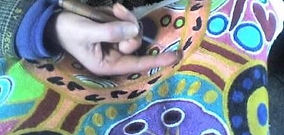
 11CRCMB1.jpg"Many Trees & Many Little Rockholes" design by Maringka Burton - Iwantja Arts. The Anangu people have special ties to totemic sites in the area and paint their connection to it. Artists use symbolism from their own individual Dreaming path, single and concentric circles, animal tracks and straight and curved lines. Wavy lines may depict travels of their ancestral beings. Royalties from the sale of this product go to the artist. |  WAJA.jpg'Mina Mina Jukurrpa' by Judy Watson. The country associated with this Jukurrpa is Mina Mina, a place far to the west of Yuendumu, which is significant to Napangardi/Napanangka women and Japangardi/Japanangka men. All of them are the custodians of the Jukurrpa that created the area. The Jukurrpa story tells of the journey of a group of women of all ages who travelled to the east gathering food, collecting ngalyipi (snake vine - Tinospora smilacina) and performing ceremonies as they travelled. The |
|---|---|
 KMTR.jpg: 'Eagle, Crow and Cockatoo Dreaming' by U. Tjangala /P. Lionel. This image is from an original painting which depicts the artists' favourite milpatjunany - sand story about a man Eagle and his two wives, crow and cockatoo. Crow was the first wife, and Cockatoo the younger and more beautiful. Crow became jealous as Eagle kept giving her the best meat and staged a plan for revenge. One day when out gathering bush foods, Crow killed the pregnant Cockatoo and then pretended to Eagle that Cockatoo |  Tjukula.png |
 seeds- better world.jpg | 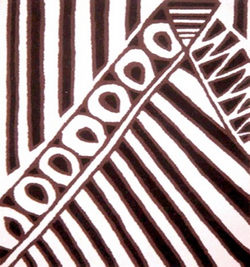 my place.png"Tjukula" design by Maringka Burton - Iwantja Arts The Anangu people have special ties to totemic sites in the area and paint their connection to it. Artists use symbolism from their own individual Dreaming path, single and concentric circles, animal tracks and straight and curved lines. Wavy lines may depict travels of their ancestral beings. Royalties from the sale of this product go to the artist. |
 kapi tjukitji.jpgKapi tjukitji design by Rosie Baker - Iwantja Arts The Anangu people have special ties to totemic sites in the area and paint their connection to it. Artists use symbolism from their own individual Dreaming path, single and concentric circles, animal tracks and straight and curved lines. Wavy lines may depict travels of their ancestral beings. Royalties from the sale of this product go to the artist. | 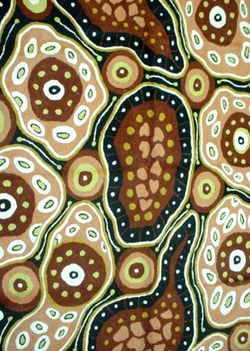 Bush food & campsite.jpg"Bush Food & Campsites" By Mary Oliver-Keringke Arts. Keringke artists use pattern, colour, shape and design to create paintings that depict their sense of country, culture and self. They are highly graphic in nature and descriptive in fine detail, clean lines and intricate designs. Royalties from the sale of this product go to the artist. |
 Better world title.png |  IDRO.jpg'Line' by Dianne Robinson. This design is from an original painting by Dianne who is a talented young artist. The title of this design refers to Dianne’s vision of the lines and fences through her community. |
 EUTP.jpg: 'Eagle, Crow and Cockatoo Dreaming' by U. Tjangala /P. Lionel. This image is from an original painting which depicts the artists' favourite milpatjunany - sand story about a man Eagle and his two wives, crow and cockatoo. Crow was the first wife, and Cockatoo the younger and more beautiful. Crow became jealous as Eagle kept giving her the best meat and staged a plan for revenge. One day when out gathering bush foods, Crow killed the pregnant Cockatoo and then pretended to Eagle that Cockatoo |  ERSA.jpg'Ngayuku ngura - My birthplace' by Rama Sampson. The image for this design is taken from an original painting. Rama's birthplace is laced with stories of the ancestral beings who created the landmarks and played vital roles in the law giving stories. Ngayuku ngura means My Place and is used by Anangu to refer to the place where their bodies first touched the ground. |
 BPED.jpg'Walka' by Phyllis Edwards. Phyllis describes her painting as Walka. Walka is any meaningful mark or pattern and may be an image on a cave wall, on rock or on sand and has cultural and ritual significance. It is used on the body during inma or ceremony. This painting is a bright depiction of tjukula – rockholes. Tjukula are found all across the desert. They are depressions in the rock that collect water after the rains. They vary in size, some are quite small while others are large enough to sw |  BDKU.jpg'Walka Tjukula (Rockhole Design)' by Daisybell Kulyuru. Daisybell describes this painting as Walka. Women and men from across the Anangu Pitjantjatjara Yankunytjatjara lands have become well known for this semi-abstract style painting. Walka are meaningful marks or patterns that are painted on the body during inma (ceremony), on rocks or cave walls, and drawn into the sand in a storytelling game known as milpatjunani. This painting shows many rockholes and the paths worn through the sand that |
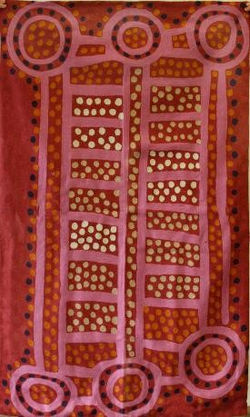 ASRO.jpg: 'Eagle, Crow and Cockatoo Dreaming' by U. Tjangala /P. Lionel. This image is from an original painting which depicts the artists' favourite milpatjunany - sand story about a man Eagle and his two wives, crow and cockatoo. Crow was the first wife, and Cockatoo the younger and more beautiful. Crow became jealous as Eagle kept giving her the best meat and staged a plan for revenge. One day when out gathering bush foods, Crow killed the pregnant Cockatoo and then pretended to Eagle that Cockatoo |  APNA.jpgYankirri Jukurrpa, (Emu Dreaming) by Pauline Nampijinpa. Singleton This particular site of the Yankirri Jukurrpa, (emu Dreaming [Dromaius novaehollandiae]) is at Ngarlikurlangu, north of Yuendumu. The ‘yankirri’ travelled to the rockhole at Ngarlikurlangu to find water. This Jukurrpa story belongs to Jangala/Jampijinpa men and Nangala/Nampijinpa women. In contemporary Warlpiri paintings traditional iconography is used to represent the Jukurrpa, associated sites and other elements. Emus are us |
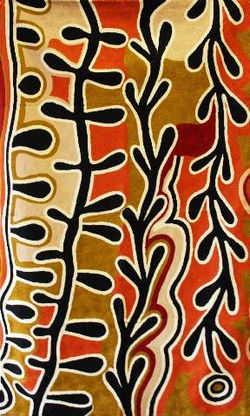 AJNN.jpg'Ngalyipi Snake Vine Jukurrpa' by Jorna Napurrurla Nelson. The country associated with this Jukurrpa is Mina Mina, a place far to the west of Yuendumu, which is significant to Napangardi/Napanangka women and Japangardi/Japanangka men. All of them are the custodians of the Jukurrpa that created the area. The Jukurrpa story tells of the journey of a group of women of all ages who travelled to the east gathering food, collecting ‘ngalyipi’ (snake vine [Tinospora smilacina]) and performing ceremonie |  Chainstich Rug_2B By Jane oliver.jpg"Bush Tracks" by Jane Oliver Keringke Arts. Keringke artists use pattern, colour, shape and design to create paintings that depict their sense of country, culture and self. They are highly graphic in nature and descriptive in fine detail, clean lines and intricate designs. Royalties from the sale of this product go to the artist. |
 15CRDH.jpg"Collecting Bush Foods" By Danela Hays Keringke Arts. Keringke artists use pattern, colour, shape and design to create paintings that depict their sense of country, culture and self. They are highly graphic in nature and descriptive in fine detail, clean lines and intricate designs. Royalties from the sale of this product go to the artist. |  15CRJO1.jpg" Bush Dreaming“ by Jane Oliver- Keringke Arts. Keringke artists use pattern, colour, shape and design to create paintings that depict their sense of country, culture and self. They are highly graphic in nature and descriptive in fine detail, clean lines and intricate designs. Royalties from the sale of this product go to the artist. |
 11CRSP3_new.jpgSuzie Prince - Iwantja Arts The Anangu people have special ties to totemic sites in the area and paint their connection to it. Artists use symbolism from their own individual Dreaming path, single and concentric circles, animal tracks and straight and curved lines. Wavy lines may depict travels of their ancestral beings. Royalties from the sale of this product go to the artist |  11CRRS_new1.jpg |
 11CRMB4_new.jpgMaringka Burton - Iwantja Arts The Anangu people have special ties to totemic sites in the area and paint their connection to it. Artists use symbolism from their own individual Dreaming path, single and concentric circles, animal tracks and straight and curved lines. Wavy lines may depict travels of their ancestral beings. Royalties from the sale of this product go to the artist. | 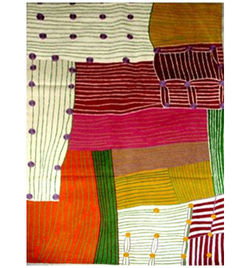 11CRMB2_New.jpg"Tribal" design by Maringka Burton - Iwantja Arts The Anangu people have special ties to totemic sites in the area and paint their connection to it. Artists use symbolism from their own individual Dreaming path, single and concentric circles, animal tracks and straight and curved lines. Wavy lines may depict travels of their ancestral beings. Royalties from the sale of this product go to the artist. |
 15CRJO3.jpg"Waterhole" By Jane Oliver Keringke Arts. Keringke artists use pattern, colour, shape and design to create paintings that depict their sense of country, culture and self. They are highly graphic in nature and descriptive in fine detail, clean lines and intricate designs. Royalties from the sale of this product go to the artist. |  Chainstitch Rug Iwantja_2.jpgArtist: "Tjukula" design by Maringka Burton - Iwantja Arts The Anangu people have special ties to totemic sites in the area and paint their connection to it. Artists use symbolism from their own individual Dreaming path, single and concentric circles, animal tracks and straight and curved lines. Wavy lines may depict travels of their ancestral beings. Royalties from the sale of this product go to the artist. |

Winya can also create the images and fabrics in the colours you need to suit your design themse or your Corporate Branding. We use Pantone Fasion and Home as our colour reference

double seater.jpg

WOGA519RW2x3 (2).jpg

Bassit 2 seater.jpg
double seater.jpg
1/27
bottom of page